

What can one image reveal about the relationship between narcissism, admiration, and power? Quite a bit, actually.
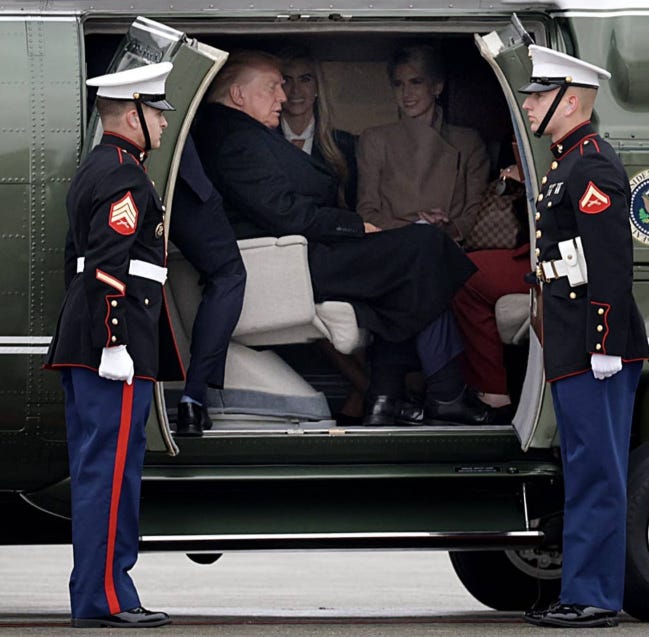
The photograph above shows Trump seated inside Marine One with two female aides, Katie Zacharia and Natalie Harp, smiling adoringly at him, and two Marines standing at attention. Look closer, and what we actually see is evidence of a deteriorating narcissist. New York Times columnist Maureen Dowd1 recently described the photo as a “bursting of Trump’s bubble.” I offer a psycho-analysis of it.
Trump being a narcissist is hardly news at this point, although how close he comes to sociopathy or true antisocial personality disorder remains controversial. Meanwhile, the signs of Trump’s regression overshadow such academic concerns. One cannot help but wonder what will happen as Trump’s personality tears apart—the psychological equivalent of a dissecting aortic aneurysm. Those never end well.
One could argue that Trump’s focus should be on wars, on inflation, on rising fuel costs, or any number of other critcal geopolitical issues. Instead, he basks in the attention of two women who are unqualified for their jobs. Zacharia lasted just five days as Trump’s White House press secretary—the shortest tenure in the position’s history. And Harp was a right-wing television personality prior to her current job of accompanying Trump every day, often into the evenings, everywhere. New York Times journalist Maggie Haberman calls her the “binky of the man-child president.”
Some Background on Malignant Narcissism:
Malignant narcissism results from a combination of biological vulnerability and disturbances in mother-infant bonding. Trump was reportedly reared in an emotionally cold, unloving home environment. As of a result of the deep emotional insecurity of such neglect, he developed a narcissistic defense, rising to the level of megalomania, a shield that communicates, “I’m so awesome that no one can hurt me.” He may never have consciously experienced the disregard; he most likely felt all-powerful by the time he came into personhood. His lifelong pursuit of women, money, and power shows his priorities.
Trump’s narcissism has devolved into an emphasis on primitive needs for attention from women, validating the regression. Always an issue for Trump, the need for feminine veneration has increased from intermittent to constant. And so has his need to show off his power. He feels so little of it inside himself, it must be abundantly delivered externally.
Returning to the photo, the two young handsome Marines who perfectly frame the picture demonstrate power. So does the Sikorsky VH-3D Sea King, one of the Marine One helicopters. Trump metaphorically shows off his “muscles” through the men and the machine.
The third and final symptom of Trump’s decline lies not in the photograph (although it can be inferred from the men and their machines), but in the monuments he builds to celebrate himself. Neither policy nor history drives these actions. Trump oversees the construction of at least four projects, including The Triumphal Arch and The White House Ballroom.
These construction schemes illustrate psychoanalyst Donald Winnicott’s2 idea of the transitional object. The phrase refers to developmental stages when infants and toddlers attach to certain objects, such as blankets or stuffed animals, as maternal substitutes. They help children to gradually recognize their mothers as separate persons rather than as extensions of themselves. Ideally, these items help children to develop the capacity to tolerate separation, manage anxiety, and establish a sense of independence.
In Trump’s case, the two-word phrase lacks one key word: transitional. He has not grown out of the need for such temporary articles; he renders them literally concrete. Trump’s expensive construction projects are much like the young women, outward expressions of him being adored. Harp is also a transitional object, albeit no longer transitional, and serves as a more literal maternal substitute than an arch or a garden.
The photograph shows a sad, regressed 80-year-old who, instead of creating meaningful national and international policy with qualified advisors to guide him, either revels in the glow of attractive maternal substitutes or plans monuments overtly or covertly carrying his name. Given his well-documented cognitive deficits and his disregard for norms and guardrails, we global citizens can do little but hope the deterioration in his narcissism will not further damage a world order already teetering on the edge.
Enjoying this newsletter? Consider a free subscription and share it with a friend.
And don’t forget to pre-order my new book, The Psychoanalyst as Revolutionary — out December 3.
References
Dowd, M. (2026). Trump’s bubble is about to burst. New York Times, Published October 17, 2026.
Winnicott, D. W. (1953). Transitional objects and transitional phenomena—A study of the first not-me possession. International Journal of Psycho-Analysis, 34, 89–97.